
Eight tried-and-tested ways to tackle a housing crisis
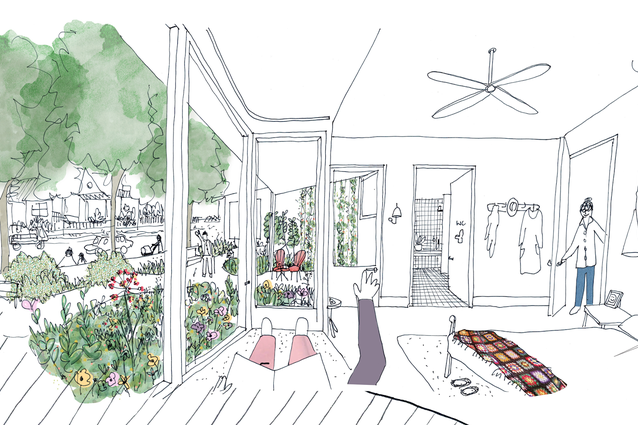
The recent Housing Actions symposium at Monash University brought together the Monash Urban Lab (MUL) and its collaborators to reflect on more than 20 years of exemplary housing research and projects.
In response to the complexity and scale of Australia’s decades-long housing crisis, MUL’s focus on strategic interventions recognises the value of a careful, methodical approach tested in existing settings, developed in partnership with public and government bodies, and refined through a triangulation of research, teaching and practice.
The designs and strategies discussed at the symposium, which was curated by MUL academic Maryam Gusheh, encompassed research from residential aged care and housing retrofit at scale to housing advocacy. Significantly, Housing Actions served as a platform to interrogate how MUL’s informal network can advance housing provision in Australia through decisive, collective action. The symposium raised these key provocations:
Convince with evidence
From dignified residential aged care to alternative dwelling provision, the status quo of housing will only be challenged when counternarratives can demonstrate how the cost, efficiency, whole-of-life sustainability metrics and lived experience of quality housing models prove they are a better choice. This means translating careful research and design logic into demonstrable data that offers policy, finance and development bodies with compelling, measurable statistics to choose differently.

Collaborate for impact
The complexity of housing requires new models of collaboration across the spectrum of spatial, operational, financial and delivery models that shape housing outcomes. These fields are typically differentiated, even adversary. By “making friends with your enemies,” architects and cross-disciplinary collaborators can achieve systemic change and demonstrate proof-of-evidence to advance pioneering housing strategies.
Account for carbon
Within the industry, we should lead by example and revise the National Construction Code to require minimum embodied carbon standards in residential buildings, additional to the more familiar performance targets of operational energy. Meanwhile, clear-sighted research evidence paired with resolute, targeted lobbying offers our best chance to compete with speculative development and drive government action to value equitable, sustainable housing targets.
Incentivise sustainability
More ambitiously, Australia needs a paradigm shift to challenge its political and economic framework, which encourages overconsumption and carbon use. Productive precedents such as Nordic environmental fiscal reform and Danish carbon pricing illustrate how federal stimulus rewards decarbonisation and provokes action.

Don’t waste buildings
The case for retrofit-oriented development can be justified by cataloguing, calculating and advocating for its positive impacts. Ageing and vacant buildings, embedded with carbon and often suitable for adaptive reuse, are also frequently found in favourable urban locations where existing transport and services support increased density. These characteristics marry with many state and local government urban frameworks to achieve resilient, liveable cities.
Value green streetscapes
A knockdown and rebuild approach overlooks impacts to the green public realm of lawns, mature trees and nature strips, which are often compromised by clearing a site. By attributing value to our green streetscapes, communicating their public health benefits, and equipping councils to reward and meet targets for retaining these green public spaces, the collective urban uplift will be significant.
Measure the human cost
Invisible costs of health, education and community resulting from the relocation of public housing residents remains unaccounted for in decisions to upgrade ageing public housing. These impacts further compromise the (often precarious) lives of residents in such housing stock. Calculating all retrofit drivers, including costs to human lives, provides a more holistic equation of cause and effect than profit-and-loss spreadsheets. As Melbourne not-for-profit design and research practice Office maps out, public housing is frequently in neighbourhoods of high cultural diversity: what is our collective civic loss when this is fragmented, or lost?

Advocate widely
Architects are skilled at synthesising many different kinds of information, but are less good at communicating their knowledge to different people: whether they be policy makers, economists or the general public. Barcelona’s Right to Housing is an inspiring precedent where demand from informed grass-roots communities in parallel with legislative change from senior officials has resulted in notable housing progress. If we want to see the same results, we need to share our knowledge about making “good” housing through a range of media, in locations and languages that speak to a wide range of audiences.
– Rebecca Roke is editorial director of Corvo (UK) and collaborates with MUL on various research projects.
link



:max_bytes(150000):strip_icc()/GettyImages-544347092-69d2e73c38f345a7baa16f89d6570186.jpg "This Kitchen Countertop Style Is So 2010s")

