
AA Jul/Aug 2025 preview | ArchitectureAu
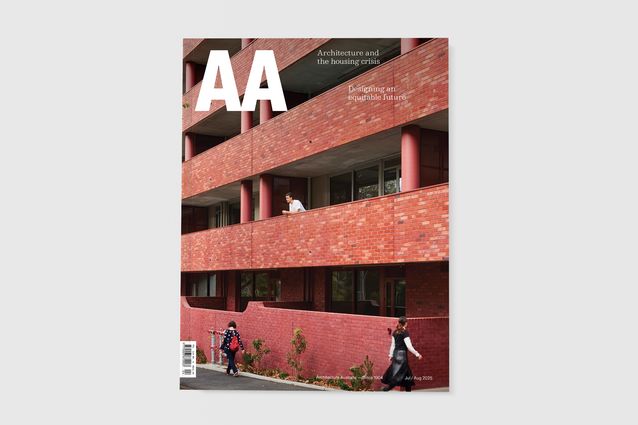
The global housing crisis is not strictly an architectural problem, but with the increasing demand for more supply, architects have a vital role to play in shifting the canon towards a more equitable housing future. This issue of Architecture Australia collects a series of exemplar housing projects that demonstrate the variety of built outcomes being delivered across Australia. To broaden the conversation, our dossier focuses on different pathways of architectural advocacy and agency in the pursuit to solve the housing problem.
The current scale of government investment in social and affordable housing in Australia has the potential to be transformative. Shiel Street North Melbourne, Community Housing Project, by Clare Cousins Architects, “illustrates the potential for dignified, design-led social housing” based around “low-cost, high-impact design,” writes Rebecca Roke. Taking a different approach and tackling a larger scale is Bangs Street, Prahran, by Jackson Clements Burrows Architects. This project in Melbourne creates 434 new mixed-tenure homes on a previously disused estate of 120 dwellings, and showcases a new public-private partnership strategy that retains longterm public ownership of the land. As Andy Fergus notes, “the project offers a number of critical lessons for the next generation of estate regeneration.”
Elsewhere, in Townsville, Mundingburra Housing by Counterpoint Architecture highlights a successful built result of the design competition and demonstration project model, which Helen Norrie argues has supported, in this case, “the agency of the architect to facilitate good design outcomes.” We also invited Rory Hyde to delve into the opportunities and realities of design competitions and demonstration projects in Australia, to reflect on whether they’re enough to shift the status quo.
Beyond the urgent need for more social and affordable housing, there is demand for models that increase density while respecting neighbourhood need. Hope Street Housing by Officer Woods Architects in collaboration with MDC Architects is a private development that turns a site originally zoned for low-volume detached homes into a series of 28 community-conscious townhouses. “It is the sort of project that is equally good for developers, residents and community,” shares Emily Van Eyk. Meanwhile, Linda Cheng explores whether the answer to our housing woes is in the stock that already exists in our suburbs. Although the built environment industry is not the sole contributor to the housing crisis or its solutions, architects have both the capacity and responsibility to champion better solutions. As Damian Madigan reminds us in a roundtable discussion with Sarah Buckeridge and Diana Snape on housing policy approaches, “You must act with hope and positivity, and you must act with conviction.” We hope this edition reminds our readers of the optimism and resilience required when advocating for change that benefits all.
This issue also celebrates the winners, commendations and shortlisted projects of the 2025 ArchitectureAu Award for Social Impact. Our joint winners, Habilis by Collins and Turner, and Munarra Centre for Regional Excellence by ARM Architecture, are examples of the shifting mode of architectural practice where social value is considered at every stage of the project. Congratulations to all recognised this year.
— Katelin Butler and Georgia Birks
Subscriptions and back issues: Print and Digital
link


:max_bytes(150000):strip_icc()/GettyImages-544347092-69d2e73c38f345a7baa16f89d6570186.jpg "This Kitchen Countertop Style Is So 2010s")

