
It’s Back, But Not The Same
When an automaker revives a sports car with a name that’s steeped in history, living up to that legend can be a near-impossible task. It needs to honor the original, modernize the formula, and also contend with the harsh expectations of the always critical online car enthusiast community. These are the trials and tribulations of the 2026 Honda Prelude, a new kind of sports coupe with some big wheels to fill.

- Base Trim Engine
-
2.0-liter inline-4 gas hybrid
- Base Trim Transmission
-
eCVT
- Base Trim Drivetrain
-
Front-Wheel Drive
- Base Trim Horsepower
-
200 hp
- Base Trim Torque
-
232 lb-ft
- Segment
-
Compact Coupe
- Honda’s best-looking car in decades
- A premium cabin worthy of an Acura
- Type R suspension makes it handle like a sports car
- It’s slower than rivals
- Back seat is tiny
- Priced like an Acura


Find 2026 Honda Prelude and more cars for sale on our Marketplace
The Prelude returns for its sixth generation after more than a two-decade hiatus. Like all previous versions, it’s a two-door sports coupe that’s loosely related to the Civic and Accord, with power going to the front wheels. Unlike any Prelude that precedes it, this sixth-generation car uses a hybrid powertrain with a new S+ shift mode that simulates real gears. A manual transmission is not on the menu. Remember what we said about expectations? It will be important as we figure out how the Prelude stacks up in the two-door coupe segment, and if it lives up to the nameplate. Honda flew CarBuzz out to San Diego to drive the car, so we could answer these questions.
First Drive events provide our initial impressions of a vehicle in a restricted environment under certain time constraints. Keep an eye on CarBuzz for our comprehensive Test Drive review which will follow soon.
What Is The 2026 Honda Prelude?
The 2026 Prelude is an all-new model, though not everything about it is bespoke. Peel away that gorgeous body, and that platform is shared with other Honda vehicles like the Civic and Acura Integra. The powertrain is also shared with the Civic Hybrid, and the subject of its power output has been a hot-button topic amongst car enthusiasts. Honda has positioned this car well above the Civic in terms of price, but below halo and luxury models like the Type R and Integra.
There aren’t many coupes left on the market, let alone a front-wheel-drive one with a hatchback and a hybrid powertrain. The Prelude is the only vehicle with all three. Most of its competitors in the same price bracket (such as the Nissan Z, Subaru BRZ, and Toyota GR86) are all rear-drive, and none are sold as a hybrid. Could this give Honda a unique place in the market for buyers who want a softer, less track-focused coupe, or will the company’s dedication to efficiency be the Prelude’s downfall?
Exterior Design: Honda Made A Stunner
|
Strengths |
Weaknesses |
|---|---|
|
|
|
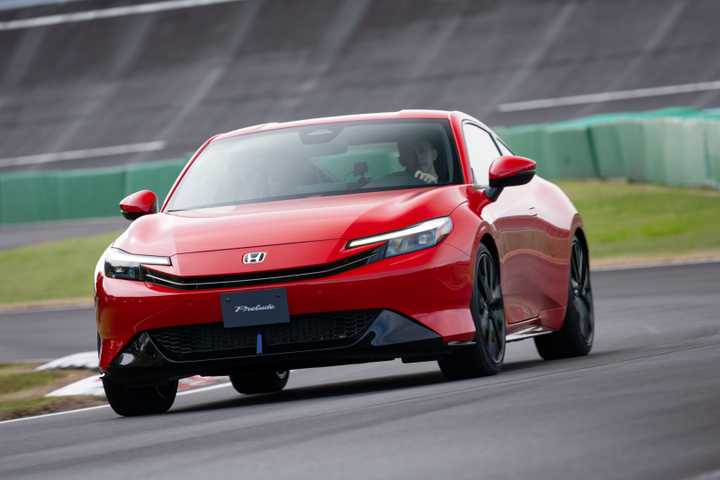
If there’s one area where even Honda’s harshest critics will bow their heads to admit the Prelude deserves praise, it’s in the styling department. This is easily the coolest-looking Honda (not counting the Acura NSX) since the S2000 left production. This is a gorgeous, curvaceous car from all angles, and it looks like a premium item.
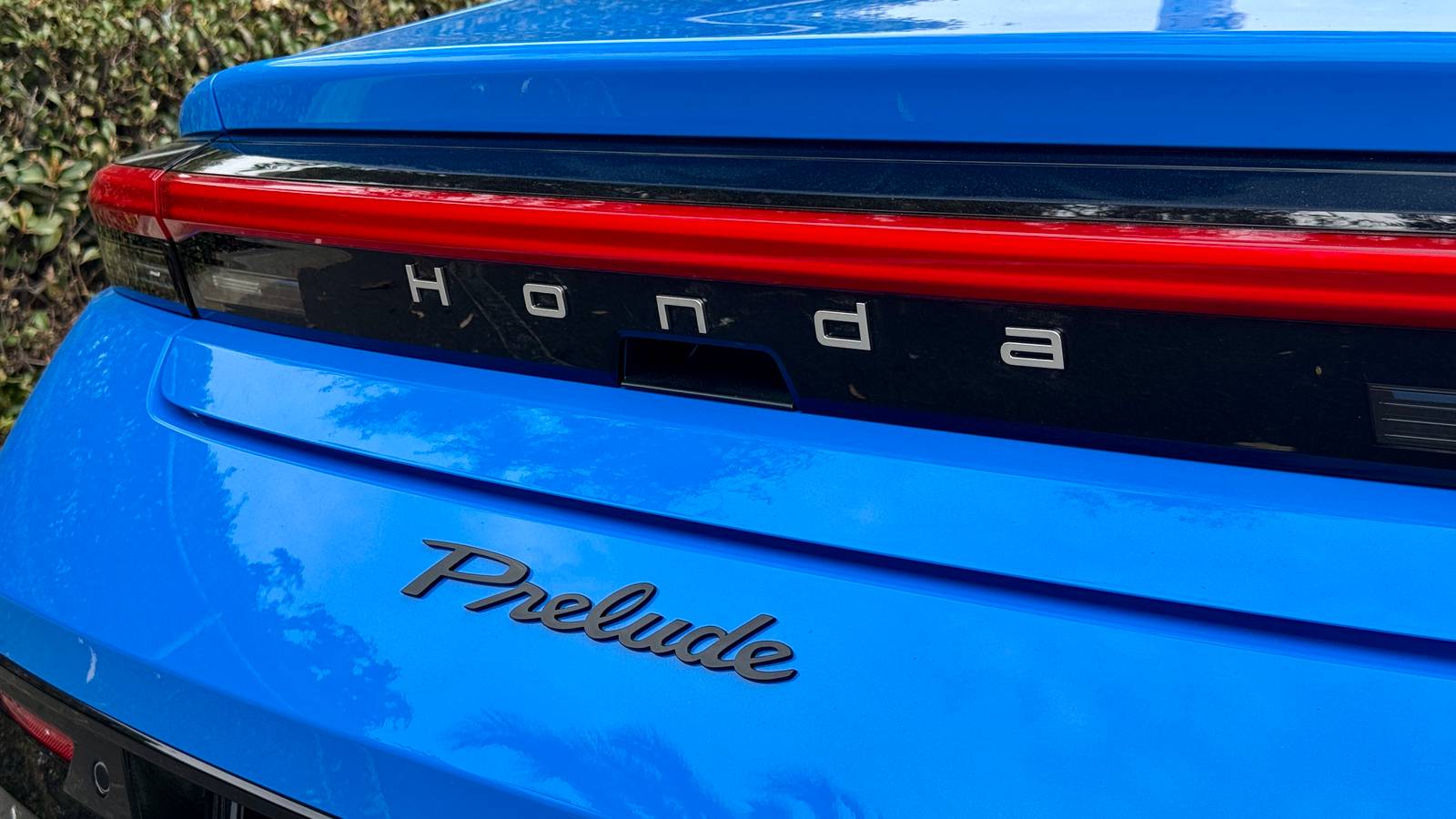
Onlookers at the First Drive event even confused it for a Porsche, likely because the Prelude badge on the rear is a cursive font that looks similar to what you might see on a 911. Adaptive LED headlights, a full-width LED taillight bar, and large 19-inch black wheels give the Prelude a modern appearance, though one could criticize it for not looking much like any of its predecessors.
Honda only offers five colors, but they are pretty comprehensive. Boost Blue Pearl and Rallye Red are the two hot hues, while Crystal Black Pearl, Meteorite Gray Metalltic, and Winter Frost Pearl are on the tamer side.
Interior: Almost An Acura
|
Strengths |
Weaknesses |
|---|---|
|
|
|
Like the Acura Integra, the Prelude borrows much of its interior from the Civic, but upgrades it with nicer seats and materials. The front seats are unique to the Prelude, and come in white or black perforated leather with standard heating. Not only do they look cool, but they have more bolstering than a Civic or Integra seat while being more comfortable than the red buckets in a Type R. We can’t say the same for the back seats, which are cramped for an adult and difficult to access because the front seats don’t tilt and slide with one lever, nor do they return to their original position.
As a plus, this car is a hatchback, so the 15.1 cubic feet of space behind the rear seats is pretty great, and you can fold down the back for more room. Elsewhere in the cabin, the Prelude gets softer materials on the dashboard, a higher center console with more padding, and simple controls that are easy to use. Sadly, Honda did not retain the sunroof, a feature that was present on every other Prelude.
Infotainment: Mostly The Same
The Prelude shares its nine-inch touchscreen infotainment system with the Civic, and there is nothing wrong with that. The screen now has Google built-in, plus Android Auto and Apple CarPlay with wireless connectivity tied to an eight-speaker Bose audio system. There’s also a 10.2-inch digital gauge cluster, though we wish it offered more customization, such as the ability to show a full map display.
Powertrain & Driving: Wider Definition Of Fun
|
Strengths |
Weaknesses |
|---|---|
|
|
|
Every Prelude features a 2.0-liter four-cylinder engine under the hood, but unlike most hybrids, it only drives the wheels through a clutch at higher speeds. Honda’s two-motor hybrid system drives the front wheels via an electric motor, which is fed via a small battery that receives energy from the gas engine, like a generator. In other words, the Prelude delivers its 200 horsepower and 232 lb-ft of torque like an electric vehicle, and less like a traditional hybrid.
Much has been made about the Prelude’s power output, but it’s identical to the fifth-generation model, which hasn’t been on sale in the US since 2001. In our testing, the Prelude felt a bit sluggish off the line before the gas engine could fully contribute to the hybrid system, resulting in a 7.22-second run to 60 mph. Putting the car into S+ only slows it down, since the planetary gears can’t pick a single RPM and stay there to achieve the quickest acceleration. In S+, we recorded an 8.67-second zero to 60 mph time.

The Prelude’s Evolution: We Drove Five Generations Of Honda’s Sports Coupe
Well, we drive four and looked lovingly at the first generation with its old-car problems.
Angry commenters will be quick to point out that a Toyota Prius is just as quick, and that Honda should have given the Prelude the engine and manual transmission from a Type R. We’d remind these dedicated fans to remember that the Prelude was never a straight-line performance car. That fifth-gen may have 200 hp, but it only produced a lowly 151 lb-ft of torque compared to the new car’s 232 lb-ft. Honda even had all five previous Prelude generations for us to drive at its event, and a quick spin in a 2001 model reminded us of how important torque can be for everyday driving.
Drive And Handling
Whereas that outgoing Prelude requires drivers to rev out the engine, thrusting it into that glorious VTEC changeover to wring out every ounce of power, the new one zips between lights in a city setting, the same way you can do in an EV. That torque is available without as much fuss, meaning you can leave the old car reading your fancy cursive Prelude script off the line.
In most driving scenarios, the engine will kick on when additional power is required, but the Prelude tries to remain moving on its electric power where possible. The included drive modes (Comfort, GT, Sport, and Individual) can alter the throttle mapping and change how easily the engine will kick on, and how much artificial sound is created in the cabin. These modes also impact the adaptive suspension, which is taken from the Civic Type R but tuned to be softer than the Integra Type S. We found the Prelude to ride far better than any Civic we’ve driven, especially in Comfort Mode. If it was a little quieter on the highway, it would make a stellar grand tourer.
No matter which mode it’s in, pushing the S+ Shift button tells the Prelude to simulate an eight-speed transmission. Instead of feeling like one gear (an eCVT as Honda calls it), the Prelude will blip RPMs, exactly as you would feel and hear in a car with real gears. It’s similar to the system found in the Hyundai Ioniq 5 N, but the Prelude has a gas engine that can rev to deliver a more realistic sound experience despite not being connected to the wheels. It can also use brake regeneration to simulate engine braking on downshifts.
On curvy roads in Sport Mode, the Prelude proves why it deserves to wear its name proudly on the back. This is a delightful little car… even without a transmission. S+ Shift’s simulated gears are nicely spaced, and we never felt like second gear was too high coming out of tight corners. Left to its own devices, the car defaults to higher gears than we’d like, but you can take manual control temporarily using the paddle shifters. Sadly, the car doesn’t stay in manual mode for more than a few seconds before going back into the default automatic mode. Honda says this was done to preserve the car’s philosophy of efficiency and attention to driving.
Even if you leave in automatic mode or turn off S+, the Prelude’s torque-rich power band is enjoyable on a back road thanks to its small size, excellent suspension, and sharp steering. This is a momentum car, just like every Prelude that preceded it, but a few details have changed: you no longer need to keep the engine revving near its max to have any torque and a manual transmission isn’t necessary to feel engagement. It may not be the same, but it’s still within the bounds of the Prelude formula, just more modern. We should also point out the Prelude is rated at 46 MPG in the city, 41 MPG on the highway, and 44 MPG combined, efficiency that far outmatches any of its competitors.
Verdict & Pricing: Expectations Matter
The 2026 Honda Prelude and its $42,000 starting price (plus a $1,195 destination charge) is all about expectations. If you only look at the 200-hp rating and the seven-second zero to sixty time, the Prelude will seem like a poor value next to a Ford Mustang EcoBoost or Nissan Z. But shocking as it might be to hear, power and straight-line performance are not the only two reasons why people might buy a sports car, and there are other reasons why the Prelude shines. The two-motor hybrid system boasts fuel efficiency that is nearly double that of the Mustang or Z in the city, and produces more torque than a Subaru BRZ/Toyota 86.
Driving the fifth-generation Prelude reminded us that this nameplate was never a big-power tuner car – it was a momentum-handling car. Though the powertrain has changed significantly, this sixth-generation Prelude stays true to its predecessors. It’s comfortable, fun on a back road, and efficient as a daily driver. If you are one of those enthusiasts who simply can’t live without a manual, there is good news! Honda still sells the Civic Si for $31,495 and the Type R offers higher performance for $46,895. Buyers wanting a nicer interior with a more coupe-like roof and more doors can opt for the Acura Integra, which offers a manual on the A Spec and Type S trims.
Sorry, we don’t live in a perfect world where Honda sells the stunning Prelude with the excellent Type R powertrain and a manual (at least not yet), but you can’t always get what you want. Honda did sell a Civic Coupe just a few years ago in the 10th generation, and only about 6% of people opted for it by the time it left the market. Of that, only 3,853 units were the Si trim with the manual; that’s below Honda’s 4,000 units-per-year goal for the Prelude. If you really wanted Honda to build the manual coupe of your dreams, you should have shown up to buy a Civic Si Coupe when the company was nice enough to offer it. The new Prelude may not be exactly what you expected, but it’s more interesting than you think, if you give it a chance.
link


:max_bytes(150000):strip_icc()/GettyImages-544347092-69d2e73c38f345a7baa16f89d6570186.jpg "This Kitchen Countertop Style Is So 2010s")
